About this spot
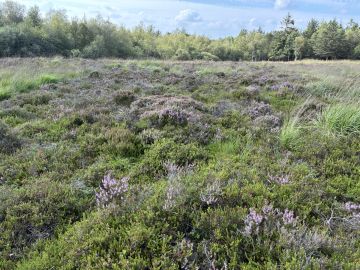
Since the late 1500s, Hesselho Heath and Bog served as common land for the nearby villages. The area was a resource reservoir from which farmers collected, among other things, peat and plant matter. Thus, farmers gathered heather peat, which they mixed with cattle manure to create compost for their agricultural land. As building material, the peat was suitable for the ridge of thatched roofs and for insulating walls. Furthermore, heather peat could be used to build fences and simple huts. Additionally, peat from the bog was used as fuel. By burning the heath, fresh shoots emerged that sheep could eat, thus the heath could also provide fodder for the sheep. Areas like Hesselho Heath and Bog provided the farmers of West Jutland with various opportunities to earn money, including wool production and stocking knitting, making ‘Jydepotter’ (Jutlandic pottery) and straw brooms, smithing, making bricks and honey, as well as other secondary occupations. Thus, the heath and bog offered a wide range of income opportunities. However, this farming method impoverished the heath, as farmers continuously removed the most nutrient-rich layers from the heath and bog. When efforts began to cultivate the heathlands in the late 1800s, Hesselho Heath and Bog were so depleted that no one wanted to cultivate or parcel out the area. Instead, the surrounding areas were cultivated and planted, and thus the area lies as the center of a cultivated landscape, telling the story of heathland use. A remnant of past nature and landscape which is unfortunately disappearing.
Facilities
Reviews
No reviews yet — been here? Reviews are coming to CampCompass soon.